
Checking Criminal History in Lebanon
Begin a Lebanon criminal records check with the event, not with a broad name search. A police incident, a booking, a district-court complaint, and a state repository response are separate records. Lebanon Police is the right first stop for a Lebanon city report. The Unified Judicial System portal is the next layer when charges reached a Magisterial District Judge or the Court of Common Pleas. Lebanon County Correctional Facility answers current custody questions, while PATCH supplies the Pennsylvania State Police name-based repository response.
The five steps below keep a Lebanon search tied to the right custodian. Use the person’s full name plus an incident number, offense tracking number, docket number, date, or address when one is known. Those facts help staff distinguish records and can reduce a request that is too broad.
- Ask the Lebanon Police Records Section for the city incident record or verification product that fits the event.
- Search both Lebanon MDJ levels in the UJS portal when the ward or district is not yet clear.
- Check Lebanon County Central Booking or LCCF by phone if present custody is the question.
- Follow a held-for-court charge to the Clerk of Courts and the Common Pleas docket.
- Use PATCH only when the Pennsylvania repository product, rather than a city case file, is needed.
Lebanon Police Record Fees
Lebanon Police works from City Hall at 735 Cumberland Street. Its Records Section has one full-time civilian and serves the public from 8:30 a.m. to 4 p.m. on weekdays. A requester should bring photo identification. Lebanon publishes two narrow products with fixed fees: a completed state accident report and an incident verification letter. Neither item is a full Lebanon criminal history, and an incident letter does not state a final court outcome.
| Lebanon record product | Published fee | What to expect |
|---|---|---|
| Completed state accident report | $15 | The completed crash record available through the police counter |
| Incident verification letter | $10 | A limited letter confirming qualifying incident information |
Call 717-272-6611 before traveling when the request involves a police narrative, photo, video, juvenile information, or an open inquiry. Release rules and redaction may differ. For a full charge history, the Lebanon court docket is the better source.
Lebanon Police Department Records
The Lebanon Police Department makes the first Lebanon record when an officer responds, investigates, or arrests. The file may include an incident number, date and place, allegations, officer details, and references to property or evidence. It can also contain material that Lebanon may withhold, such as active investigative information, victim details, juvenile information, or security-sensitive facts. Asking for a specific existing record works better than asking Lebanon to create a broad personal history.
The official Lebanon police page shows the department and its city contact channel.
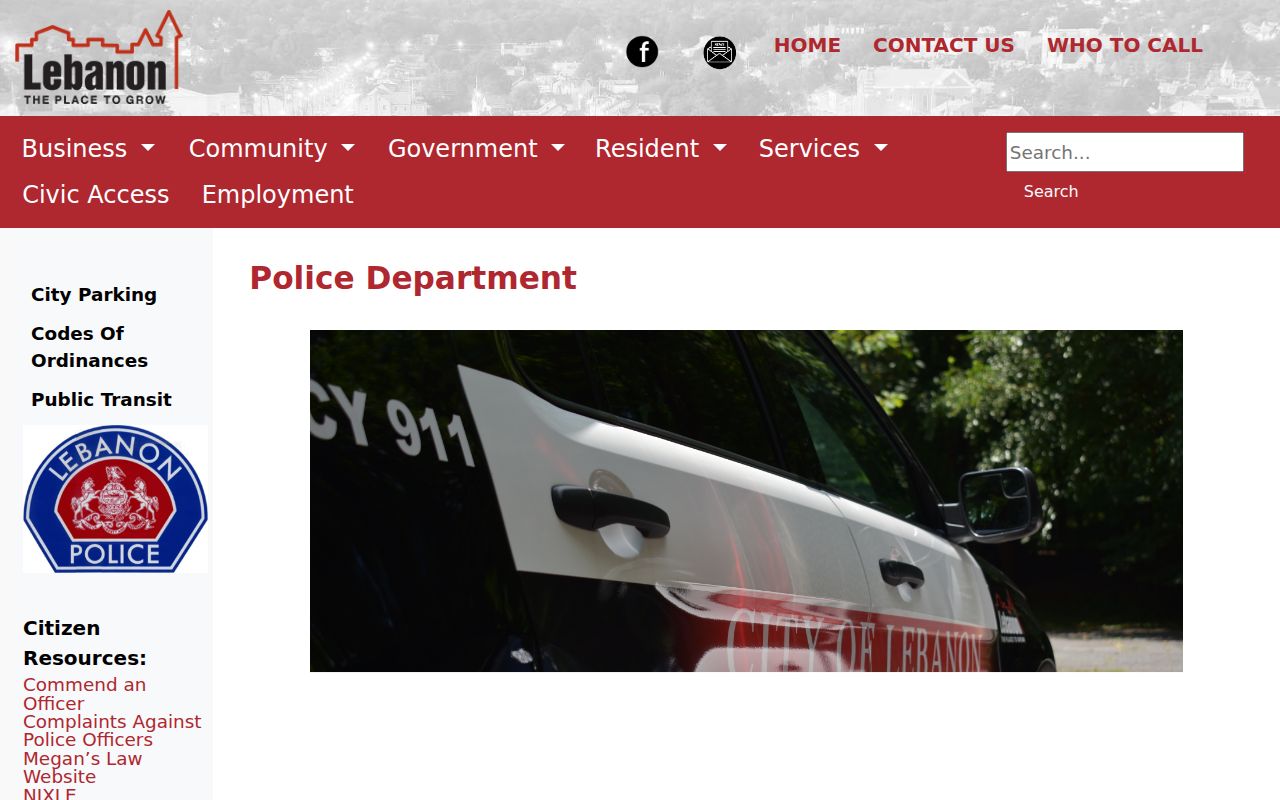
The image helps identify the official Lebanon Police source, which should be checked before relying on copies or summaries found elsewhere.
After-Hours Lebanon Police Reports
Lebanon has a clear route when the police counter is closed. Emergency calls go to 911. Nonemergency after-hours reporting routes through Lebanon County Emergency Management at 717-272-2054. That channel helps report a Lebanon event; it is not a late-night Lebanon records desk. Existing Lebanon reports still belong with the Records Section during its public hours.
When a caller is trying to find a recently arrested person, contact LCCF about Lebanon custody rather than EMA. When a court appearance or bench warrant is the concern, use the issuing court or sheriff. Matching the need to the office prevents a request for Lebanon criminal records from landing in an emergency communications channel that cannot release the file.
Note: After-hours reporting can start a police response, but copies and incident verification remain daytime records functions.
Lebanon Arrests and Bookings
Lebanon does not keep people in a Lebanon city jail after arrest. Officers transport them into Lebanon County’s Central Booking process, and LCCF creates the custody file if the person is committed. Booking can add identity and property intake, fingerprints, a photograph, complaint and OTN links, screening, bail information, and custody status. Those items are not all shown in one public profile, and Lebanon County has no official public jail roster or mugshot gallery.
For recent Lebanon custody, call the Lebanon County Correctional Facility at 717-274-5451. Then search the appropriate MDJ docket for the complaint, preliminary arraignment, bail, and hearing entries. A charge held for court moves to Common Pleas. The fuller county channel list is described in the Lebanon County arrest lookup. An arrest entry records an allegation and processing event, not guilt.
Lebanon Criminal Dockets by Ward
Lebanon is divided between MDJ 52-1-01 and MDJ 52-2-01. Both courts are at 502 State Drive, yet the street address or ward tied to the incident determines the district. That split can trip up a Lebanon case search. Finding no Lebanon result under one district does not show that no case exists.
Search the Unified Judicial System Case Search with Lebanon County selected and start with a minimally constrained participant name. Check MDJ Criminal and, when needed, Traffic or Non-Traffic dockets. Use the OTN or originating docket to connect a lower-court record to a Common Pleas case. Thursday preliminary hearings may be part of local scheduling, but confirm a particular hearing through its docket or the assigned Lebanon MDJ.
- MDJ docket
- The complaint, bail, preliminary hearing, or summary-level record.
- OTN
- The offense tracking number that can link police processing and court data.
- Common Pleas docket
- The county trial-court file after a misdemeanor or felony is held for court.
Municipal Court Records in Lebanon
Lebanon has no separate court called a municipal court. Pennsylvania uses Magisterial District Courts for preliminary criminal work, traffic, non-traffic, and most summary matters.
Felony and misdemeanor cases held for court go to the Court of Common Pleas of Lebanon County. The anchor phrase “municipal court records” therefore points readers to the two Lebanon MDJs and then to the Clerk of Courts, not to a city-run court.
| Court Name | MDJ 52-1-01 or 52-2-01; Court of Common Pleas for held-for-court cases |
|---|---|
| Case Types Heard | Complaints, preliminary arraignments, bail, hearings, traffic, non-traffic, and summary matters at MDJ level |
| Case Lookup Channel | UJS Case Search, the assigned MDJ counter, or Lebanon County Clerk of Courts |
| What the Docket Shows | Charges, filing dates, OTN, bail, events, disposition, sentence, and money fields as applicable |
| Copies & Fees | Ask the record-holding court; Clerk copies are listed at $0.50 per page and certifications at $15 |
Lebanon Verification Versus Case Records
A Lebanon incident verification letter, a UJS docket, and a PATCH result answer different questions. The police letter is narrow proof tied to an incident, while the court docket shows filed charges and their course.
PATCH reports releasable Pennsylvania criminal-history information matched through the state repository. A “No Record” PATCH response does not prove there was never a Lebanon arrest, sealed case, out-of-state event, or record not disseminated by the repository.
| Lebanon source | Best use | Key limit |
|---|---|---|
| Police Records Section | City report or incident verification | Not the final court history |
| UJS docket | Filed case events and outcome | Not every filed image is public |
| PATCH | State repository response | Not a complete city or court-file search |
Where Lebanon Records Go
A Lebanon police event can produce several connected files. Police create the incident or arrest record. Central Booking creates intake data. An MDJ handles the first court phase and bail. Charges held for court move to the Clerk of Courts, while the final disposition should return through the reporting chain to the Pennsylvania State Police Central Repository.
Record flow: Lebanon Police › Lebanon County Courts › Pennsylvania State Police Central Repository
Timing gaps are normal. A new Lebanon arrest might reach booking before a UJS docket appears. A docket can show a filing that PATCH does not release. Older paper files, identity matching, expungement, limited access, and late disposition reports can also create differences. Compare the sources and ask the originating office to correct its own data when a record is wrong.
Correction should follow the same chain. If the Lebanon police report contains the error, begin with the department. If a Lebanon docket has the wrong disposition, obtain the court record needed to address it through the court custodian. When the source court or police data is fixed, notify the Pennsylvania State Police through its record-review and challenge channel if the repository response still differs. Supplying an OTN, control number, docket number, and certified disposition where requested gives each office a clear link to the disputed Lebanon event. Changing only one downstream copy can leave the bad source data ready to be sent again.
Lebanon Criminal Record Requests
Broader Lebanon city requests go to the Open Records Officer at City Hall. The city can be reached at 717-639-2800, option 5, by fax at 717-639-2802, or at openrecords@lebanonpa.org. Its form asks how and when the request was submitted, requester contact details, a specific description of the record, and choices for inspection, copies, certification, or delivery.
Do not send every Lebanon police request to the general Lebanon city officer. Police investigative records follow special rules, and appeals involving criminal investigative records route through the District Attorney rather than ordinary Office of Open Records review. A focused request should name the record type, a short date span, incident location, and an incident or docket number if known. It should not ask the city to research a person and assemble a new criminal history.
Lebanon Record Geography and History
Lebanon began as Steitztown, was renamed Lebanon in 1758, became a borough in 1799, and developed into the county’s only incorporated city. It now operates under Home Rule. That civic history also helps explain why Lebanon record offices sit in two downtown government systems: the city handles police and general city records, while county government handles Common Pleas files, booking, jail custody, prosecution, and many court services.
The official Lebanon history page provides the city’s own account of that development.
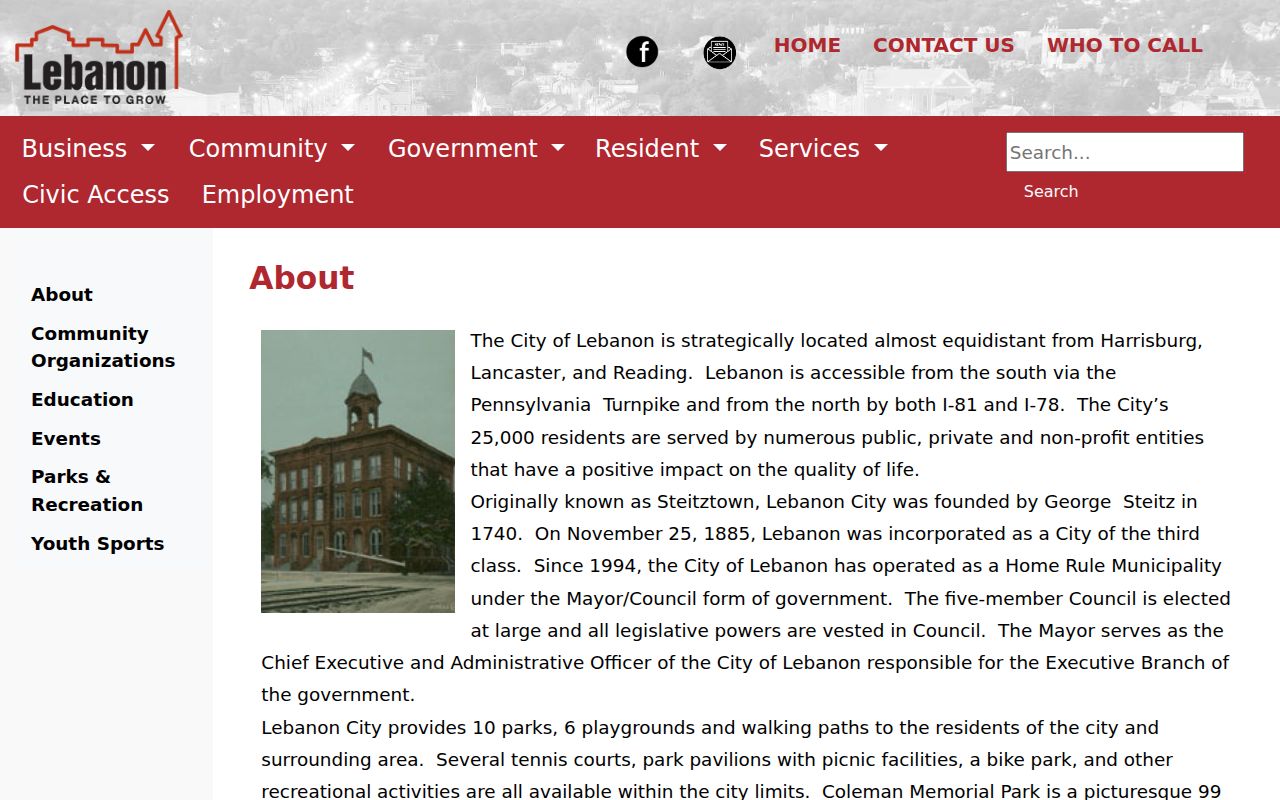
The historic city view anchors Lebanon records in the municipality that created them without blurring city files into Lebanon County court custody.
Modern Lebanon covers 4.17 square miles and maintains ten parks plus six playgrounds. Those figures describe city geography, not police activity. The mayor characterized the city’s 2024 serious-crime count as the second lowest in Lebanon statistical history, but the official material did not publish the underlying table needed to calculate or test a rate. Treat that statement as the city’s limited claim, not as a substitute for case records. A person researching one Lebanon event should still use the police incident, MDJ district, booking route, and court disposition. Broad civic numbers cannot show whether a named case exists or what its outcome was.
Public Access Rules in Lebanon
Access depends on the record, not merely on the fact that a Lebanon agency holds it. City administrative records are assessed under Pennsylvania’s Right-to-Know Law. Police intelligence and investigative information can be restricted. Court files follow the Unified Judicial System access policy. Criminal-history dissemination and correction are governed by CHRIA. Juvenile, victim, financial, sealed, expunged, and limited-access data can be withheld or redacted.
Key Statutes:
Pennsylvania Right-to-Know Law presumes qualifying agency records public but provides investigative and privacy exemptions.
Criminal History Record Information Act controls criminal-history collection, dissemination, review, and expungement.
UJS Case Records Public Access Policy governs public access and protected fields in Pennsylvania court files.
Start with the Lebanon office that made the record. That choice gives staff the best chance to locate it and supplies the correct appeal or correction route if access is denied.